
When sourcing aluminum profiles for industrial or architectural projects, the selection of an appropriate alloy is a critical determinant of project success. Two of the most extensively utilized alloys in the global market are 6061 aluminum profiles and 6063 aluminum profiles. Despite their superficial similarity, their distinct chemical compositions, mechanical properties, and performance characteristics render them uniquely suited to specific applications.
1. Chemical Composition: The Foundation of Their Differences
The fundamental distinction between 6061 aluminum and 6063 aluminum lies in their chemical compositions, which directly govern their mechanical behaviors, formability, and surface quality. Both alloys fall under the 6xxx series (magnesium-silicon alloys), but the precise proportion of alloying elements and the addition of auxiliary components differentiate their performance characteristics.
6061 aluminum profiles are formulated with higher concentrations of magnesium (1.0-1.6%) and silicon (0.4-0.8%), complemented by trace additions of copper (0.15-0.40%) and chromium (0.04-0.35%). These alloying elements synergistically enhance the material’s tensile strength, yield strength, and wear resistance, making 6061 the preferred choice for heavy-duty industrial applications. In contrast, 6063 aluminum profiles feature a more streamlined composition, with lower magnesium (0.45-0.9%) and silicon (0.2-0.6%) content, and no copper or chromium additives. This simplified formulation optimizes the alloy’s extrudability, enabling the production of complex cross-sections while delivering a more uniform, defect-free surface finish—critical for architectural and decorative applications.
2. Mechanical Properties: Strength vs. Formability
For international buyers, a comprehensive understanding of mechanical properties is essential when selecting industrial aluminum extrusions. The comparative performance of 6061 and 6063 aluminum profiles is outlined below:
6061 aluminum profiles are characterized by superior mechanical strength. When heat-treated to the T6 temper (solution heat-treated and artificially aged), they achieve a tensile strength of 310 MPa (45,000 psi) and a yield strength of 276 MPa (40,000 psi), outperforming 6063 in load-bearing and structural applications. This alloy also exhibits excellent weldability via MIG, TIG, and resistance welding processes, along with adequate corrosion resistance—though slightly inferior to 6063—making it suitable for harsh industrial environments.
6063 aluminum profiles prioritize formability and surface quality over raw strength. In the T5 temper (artificially aged without solution heat treatment), they deliver a tensile strength of 210 MPa (30,000 psi) and a yield strength of 172 MPa (25,000 psi)—sufficient for non-heavy-duty applications. Its core advantage lies in its exceptional extrudability, which allows for the production of intricate, thin-walled architectural aluminum profiles with tight dimensional tolerances (typically ±0.05mm). Additionally, 6063 demonstrates superior corrosion resistance, particularly in outdoor environments, and its homogeneous surface readily acceptsanodized aluminum finishes, ensuring consistent coloration and aesthetic appeal for visible applications.
3. Surface Finish: Aesthetic vs. Functional
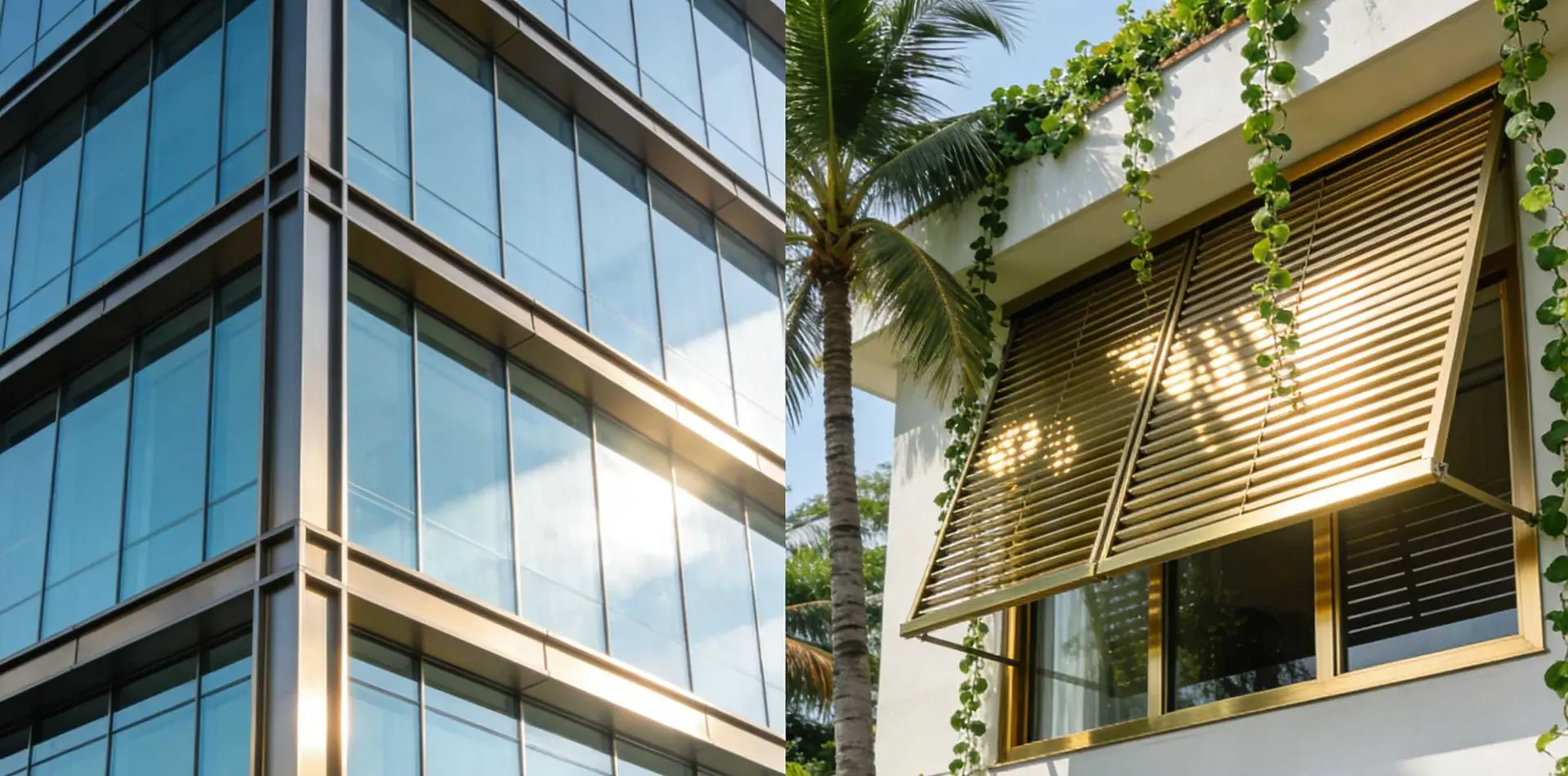
Surface quality is another pivotal differentiator with direct implications for application suitability. 6063 aluminum profiles feature a naturally smooth, homogeneous surface with minimal extrudate defects (e.g., die lines, oxide inclusions), which enables superior adhesion of anodized aluminum and powder coatings. This makes 6063 the industry standard for visible applications, including curtain walls, window frames, and decorative aluminum extrusion frames, where aesthetic consistency is paramount.
In contrast, 6061 aluminum profiles exhibit a slightly rougher surface texture, attributed to their higher alloy content and the presence of copper and chromium additives. While they can be subjected to anodization and powder coating, the finished surface may not achieve the same level of uniformity as 6063. As such, 6061 is more appropriately deployed in functional, non-visible applications, such as aluminum profiles for automation, industrial machinery frames, and structural supports, where performance takes precedence over aesthetic perfection.
4. Real-World Applications: Which Alloy Should You Choose?
To facilitate informed decision-making, the following are common applications for each alloy, derived from AluGreat’s extensive experience collaborating with global clients:
6061 Aluminum Profiles Uses: Industrial machinery frames, t-slot aluminum profiles for assembly lines, automotive components, marine structures, and heavy-duty custom aluminum extrusions. A German automotive supplier recently selected our 6061 profiles for their electric vehicle battery frames, citing the alloy’s superior strength and weldability as critical factors.
6063 Aluminum Profiles Uses: Architectural curtain walls, window and door frames, decorative trim, anodized aluminum profiles for building facades, and exhibition stands. A European construction firm opted for 6063 profiles for a shopping mall facade project, leveraging the alloy’s optimal balance of formability and aesthetic appeal.
5. Cost Considerations for International Buyers
Cost remains a primary consideration for global importers, and the two alloys exhibit modest price differences. 6063 aluminum profiles are generally more cost-effective than 6061, as their simplified chemical composition and streamlined extrusion process reduce manufacturing costs. This makes 6063 an economical choice for high-volume architectural projects.
6061 aluminum profiles incur a slightly higher cost due to their elevated alloy content and more complex production process. However, this investment is justified for applications requiring exceptional strength and durability. As a reliable aluminum profile supplier, AluGreat assists buyers in balancing cost and performance to maximize value within their budget constraints.
Final Guide: How to Choose Between 6061 and 6063
In summary: 6061 aluminum profiles are recommended for projects requiring high strength, load-bearing capacity, and weldability—making them ideal for industrial, automotive, and heavy-duty applications. 6063 aluminum profiles are preferable for applications prioritizing formability, a smooth surface finish, corrosion resistance, and cost-effectiveness—perfect for architectural and decorative purposes.
AluGreat specializes in the production of both 6061 and 6063 aluminum extrusions, offering custom aluminum profiles tailored to specific project requirements. Whether high-strength industrial profiles or sleek architectural designs are required, our state-of-the-art manufacturing facilities and rigorous quality control processes ensure that all orders meet international standards.
If uncertainty persists regarding alloy selection, please contact our team of experts. As a trusted aluminum extrusion manufacturer, we are committed to assisting clients in navigating the differences between 6061 and 6063 aluminum profiles and selecting the optimal aluminum profiles for their projects—backed by competitive pricing and efficient global shipping.